
 English


Injection molding is a widely used manufacturing process for producing high-quality plastic parts with intricate designs. Over the years, advancements in technology have led to the development of various advanced injection molding techniques that enhance efficiency, precision, and overall productivity. In this article, we will delve into some of the cutting-edge injection molding techniques that are revolutionizing the industry.
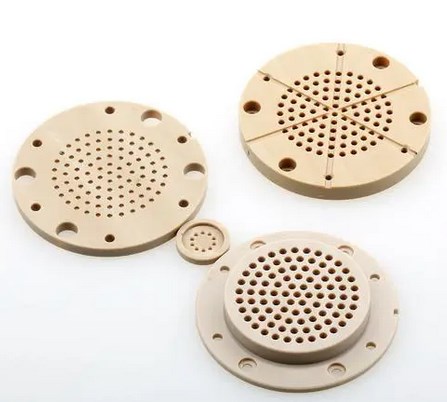
Gas-assisted injection molding is a technique that introduces nitrogen or other inert gases into the mold during the injection process. By injecting gas into the mold cavity, hollow sections or specific design features can be created within the plastic part. GAIM offers numerous advantages, such as reducing part weight, minimizing sink marks and warpage, improving surface finish, and enhancing material distribution.
The process involves injecting molten plastic into the mold cavity, followed by the injection of gas through the same or separate channels. As the gas displaces the molten plastic, it pushes it against the mold walls, forming hollow sections. This technique is particularly useful in manufacturing large, structurally complex parts and optimizing material usage.
As one of advanced molding technology, water assisted injection molding(WAIM) is used to produce lightweight, hollow plastic parts with excellent surface quality and dimensional stability. Comparing to gas assisted injection molding, water-assisted injection molding injects pressurized water into the molten plastic to create hollow channels inside thick sections.
| Feature | Water-Assisted | Gas-Assisted |
|---|---|---|
| Cooling Efficiency | Very high | Moderate |
| Internal Surface Smoothness | Excellent | Good |
| Best for | Tubular / pipe-like parts | Thick ribbed structures |
| Cycle Time | Shorter | Longer |
| Equipment Complexity | Higher | Lower |
In-mold decoration is an advanced technique that combines decoration and injection molding into a single process. With IMD, a pre-printed or pre-fabricated decorative film or foil is placed in the mold cavity before injecting the molten plastic. During the injection process, the plastic material bonds with the decorative film, creating a seamless integration of design and functionality.
IMD offers numerous benefits, including enhanced aesthetics, durability, and resistance to wear and tear. It enables the production of parts with intricate patterns, textures, and logos without the need for secondary operations like painting or post-decoration. IMD is widely used in industries such as automotive, consumer electronics, and appliances.
Micro-injection molding is a specialized technique used for the production of small, intricate parts with high precision and accuracy. This technique involves injecting a minimal amount of molten plastic into extremely small mold cavities, typically ranging from micrometers to a few millimeters.
Micro-injection molding finds applications in various industries, including medical devices, electronics, and microfluidics. It enables the production of components such as microfluidic chips, micro-optical lenses, micro gears, and connectors. This technique demands strict control over process parameters, tooling design, and material selection to achieve precise replication of micro-sized features.
Multi-material injection molding, also known as overmolding or two-shot molding, involves the simultaneous injection of two or more different materials into a single mold cavity. This technique allows for the combination of various materials with different properties, colors, or textures in a single part, opening up new possibilities for design and functionality.
Overmolding offers several advantages, including improved product aesthetics, enhanced grip and feel, vibration dampening, and the integration of soft-touch surfaces. It is commonly used in the production of automotive components, consumer electronics, medical devices, and household appliances.
Insert molding is an advanced injection molding process in which pre-formed components—typically metal parts—are placed into a mold cavity before molten plastic is injected around them. The plastic solidifies and bonds to the insert, creating a single, integrated component in one production cycle. This technique eliminates secondary assembly operations while improving structural strength and product reliability.
Threaded brass inserts
Electrical terminals
Metal reinforcement structures
As one of advanced injection molding processes, thin-wall injection molding is used to produce parts with very thin wall sections—typically less than 1 mm thick—while maintaining structural integrity, dimensional accuracy, and high production speed. Due to the thin-wall usually means the shorter molding cycle time, this technique is widely used in high-volume industries where lightweight design, material savings, and fast cycle times are critical.
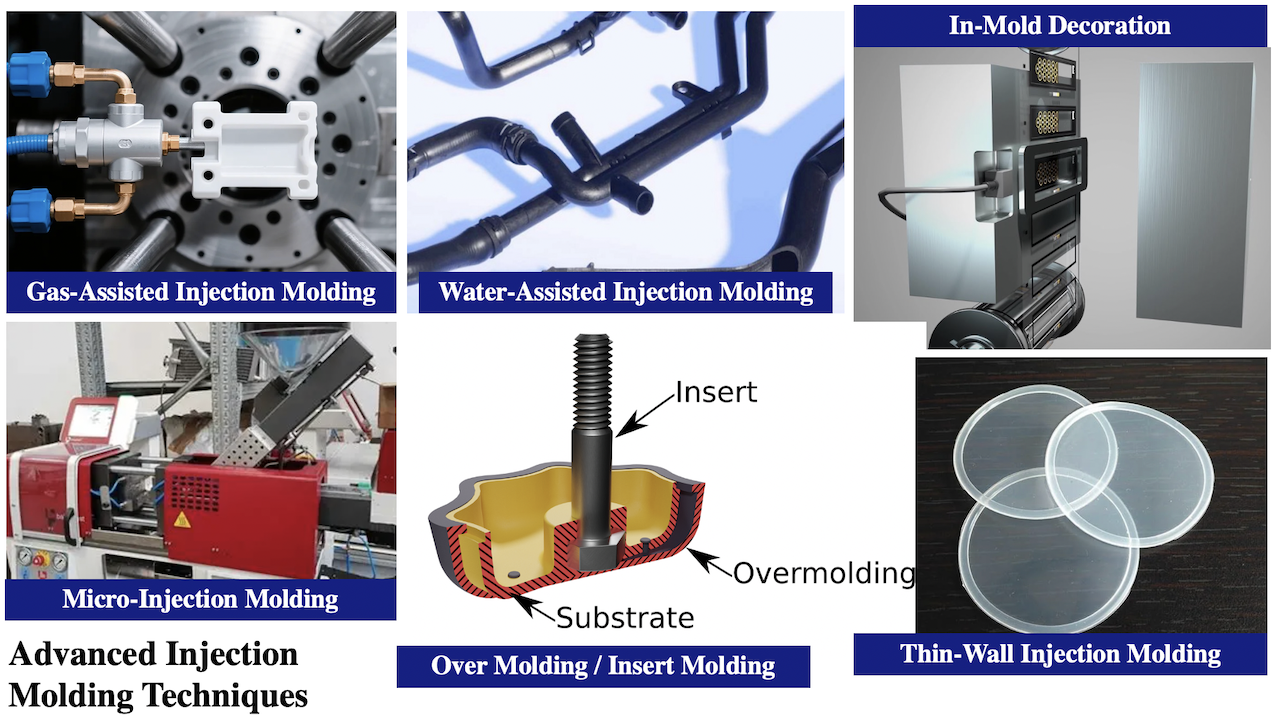
Advanced injection molding techniques have transformed the manufacturing landscape by enabling the production of complex, high-quality plastic parts with enhanced functionality and aesthetics. Gas-assisted injection molding, in-mold decoration, micro-injection molding, and multi-material injection molding are just a few examples of the innovative techniques pushing the boundaries of traditional injection molding.
As technology continues to evolve, we can expect further advancements in injection molding techniques, leading to improved efficiency, reduced costs, and expanded possibilities for design and customization. These developments will undoubtedly contribute to the growth and diversification of industries that rely on injection molding as a vital manufacturing process.
Have questions about advanced injection molding techniques or ready to start your project? Our experienced team at TEAM MFG offers expert guidance and tailored solutions — from design support to high-precision production.
Mobile: +86-15625312373
Email: ericchen19872017@gmail.com
Whether you need prototype parts, insert molding, gas-assisted molding, or high-volume production, we’re here to help.
Get in Touch:
Use the form below to send us your design files, specifications, or questions — we usually respond within one business day.
Contact Form
· Name
· Company
· Phone
· Project Details / Message
· Upload CAD File (up to 20 MB)
We look forward to partnering with you to bring your product ideas to life with precision and efficiency.